In the construction of soccer fields, many people mistakenly believe that the more rigid the perimeter fencing, the better. In reality, this is not the case; the high-intensity nature of soccer dictates that its fencing must adhere to a design logic of "yielding to overcome force."
1. Physical Mechanics: From "Rigid Collision" to "Kinetic Energy Dissipation"
When a soccer ball is struck with full force, its instantaneous velocity can exceed 100 km/h.
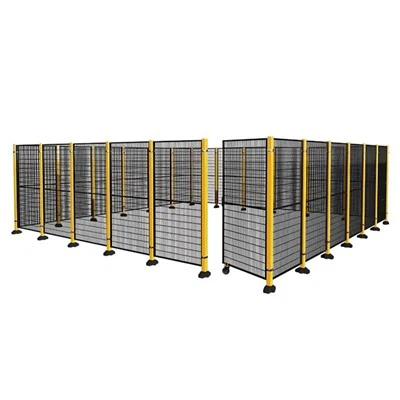
The Hidden Dangers of Rigid Fencing (e.g., Welded Mesh): When a ball or a player's body impacts a rigid fence, the contact duration is extremely brief. According to the impulse-momentum theorem, this implies a massive instantaneous impact force. This not only causes the ball to rebound violently (potentially injuring players on the field) but can also result in fractures or severe soft-tissue contusions for players involved in the collision.
The Advantages of Woven Mesh (Flexible Structure): Diamond-patterned woven mesh (commonly known as Chain Link) is a non-welded, flexible structure. When subjected to impact, the point of contact rapidly transfers energy to surrounding nodes, utilizing the elastic deformation of the entire mesh surface to extend the duration of the impact force.
Conclusion: By extending the contact time and reducing the instantaneous impact force, this "energy-absorbing" mechanism establishes the fundamental safety baseline for professional-grade soccer fields.
2. The Elastic Memory of Chain Link Fencing
The core secret behind specialized soccer field fencing lies in its weaving technique.
Structural Characteristics: Chain Link fencing is constructed from individual strands of spiral-wound stainless steel or PVC-coated wire, interlocked with one another. It lacks fixed weld points, granting it exceptional capacity for "stress release."
Automatic Recovery: High-quality low-carbon steel wire possesses an excellent elastic limit. Provided the impact force remains within the designed tolerance, the mesh surface will automatically revert to its original shape after deformation-unlike welded mesh, which is prone to weld-point fractures or permanent indentations when subjected to excessive force.
3. Player Protection: Skin Friction Coefficient and Protective Coatings
Soccer field fencing serves not only to contain the ball but, more importantly, to protect the players. When attempting to save a ball, players' bodies frequently slide laterally against the perimeter fencing. Micro-Design of PE Coating: The surface of high-quality soccer field fencing features a polymer coating made of PE (polyethylene). The coefficient of friction for this material has been optimized; compared to bare metal wire or rough painted surfaces, it is significantly smoother and possesses a slight degree of elasticity.
Scratch-Resistant Treatment: The edges of professional-grade fencing typically undergo a crimping or bending process to ensure that no sharp metal ends are exposed. Even if a player brushes against the fence at high speed, the PE layer acts as a protective film, preventing skin abrasions or snagging and tearing of clothing.
4. Visual Transparency and Fatigue Resistance
Visual Optimization: The standard diamond mesh aperture-ranging from 50mm to 60mm-ensures excellent light transmission while maintaining structural integrity. This minimizes visual obstruction for spectators in the stands and facilitates clear camera shots for capturing key moments of the match.
Fatigue Resistance Testing: Soccer field fencing may be subjected to hundreds of impacts every day. The flexible, interlocking mesh structure effectively disperses alternating stresses; consequently, its fatigue life is typically 3 to 5 times longer than that of standard welded mesh fencing.