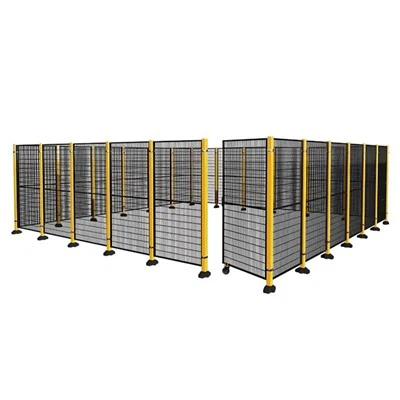
The ventilation and light transmission principle of interlocking steel grating primarily stems from its unique structural design. It consists of load-bearing flat steel bars and crossbars arranged at specific intervals, which are then welded together using a pressure welding machine to form an integral structure with numerous gaps. These gaps provide channels for the flow of air and light.
In terms of ventilation, air can flow freely within the gaps of the grating, creating a natural ventilation effect. When airflow encounters the grating, it is not significantly obstructed and can pass smoothly through, thus achieving air exchange and circulation. This ventilation performance is crucial for places requiring good ventilation, such as industrial plants and warehouses, effectively improving indoor air quality and reducing stuffiness and odors. In terms of light transmission, light can penetrate through the gaps in the grating, providing ample natural lighting.
This not only saves energy but also creates a bright and comfortable working environment. Moreover, due to the uniform distribution of the grating gaps, the light distribution is also relatively uniform, without obvious shadow areas. Furthermore, the ventilation and light transmission performance of interlocking steel grating is also related to the size and shape of its gaps. A well-designed gap structure can ensure ventilation and light transmission while meeting the load-bearing capacity and other usage requirements of the grille.